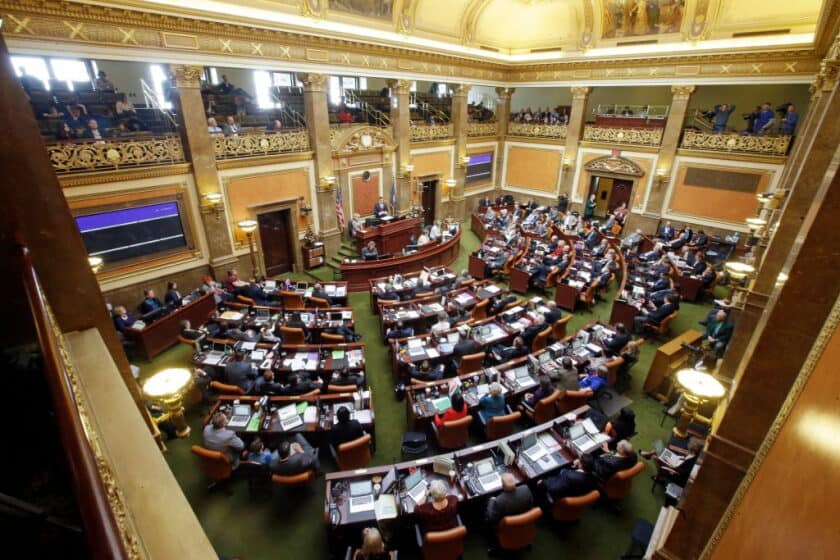
On January 11, 2024, the Utah State Board of Education voted 8-7 to keep and require “the Education Equity Rule” which implicitly includes Critical Theory education in Utah school curriculums.
After Governor Cox signed H.B. 261 Equal Opportunities Initiatives in to law, the Utah State School Board amended the equity rule R227-328 on February 2, 2024 to “prohibits some equitable practices in public schools.”
This “newspeak” sounds harmless on the surface, but what does it mean for you, your children, and grandchildren? Let’s first learn the meaning of this newspeak.
What is Equity? Equity as defined in the public administration literature by George Frederickson as an administered political economy in which shares are adjusted so that citizens are made equal. What are the “shares” that are to be made equal? In addition to economic and material capital, Equity includes social and cultural capital.
Pop Quiz: What is the economic and political system that redistributes shares of capital to make its citizens equal?
Utah.gov confirms this with the R277-328 definition of Educational Equity as “(i) acknowledging that all students are capable of learning and (ii) distributing resources to provide equal opportunities based upon the needs of each individual student.”
Notice how your head nods in agreement on point (i) and then we’re taken in on point (ii). Does it sound like the ideology of Karl Marx, “from each according to his ability, to each according to his needs” to you?
Ok, but so what? Is this bad or wrong for Utah students? Let’s dig deeper to find the answer.
Under the Equity umbrella is an ideology called Critical Theory which the Utah curriculum includes implicitly, even if not expressly stated. What is Critical Theory? Critical Theory is a secular ideology that believes that all human relationships are based only upon power dynamics. Critical theorists maintain that a primary goal of philosophy is to help overcome the social structures through which people are dominated and oppressed (source Britanica.com). Thus, all human relationships are distilled down into powerful “oppressors” and the victimized, the “oppressed.”]
One subset of Critical Theory is called Critical Race Theory or CRT. This theory asserts the premise that race is not a natural, biologically grounded feature of physically distinct subgroups of human beings but a socially constructed category that is used to oppress and exploit people of color (source Britanica.com).
CRT teaches if one ethnicity has more perceived power than another ethnicity, they gained that power by victimizing and oppressing the ethnicity with lower perceived power. CRT teaches that to be moral, the founding principles of the United States must be thrown out because many of the founders themselves owned slaves, that the success of the U.S. was only possible by slavery and oppressing workers and minorities.
If you don’t believe me, ask yourself why are the statues of the founding fathers and historical American figures being taken down from public buildings and public squares in many parts of the country?
Propagation of this ideology will cause some impressionable students to hate their neighbor while others feel inescapable shame because of the color of their skin. If a white student comes from a family with economic success, they will be taught that they did not achieve that through hard work, merit, and the content of their character, but rather through oppressing weaker minorities and “people of color.”
The soulless ideology of Equity which includes Critical Theory and Critical Race Theory is wrong because this ideology is without love. Ask yourself, if all human relationships are based upon power, how can any love be present? How can a husband love his wife, a wife love her husband, parents love children, children love parents; and how can anyone love their neighbor if all human relationships are only an interplay of power?
Believers in Jesus Christ offer an alternative. We believe that the basis for all human relationships is love. A love that places the other in front of yourself. A love that sacrifices for the betterment of the other. And yes, we fail at loving our neighbor all the time. That doesn’t mean we stop striving to love our neighbor better.
Jesus commands us, “You shall love the Lord your God with all your heart, with all your soul, and with all your mind. This is the first and great commandment. And the second is like it: You shall love your neighbor as yourself.” (Matthew 22:37-39). Jesus further commands us, “A new commandment I give to you, that you love one another; as I have loved you, that you also love one another.” (John 13:34)
Even if you don’t believe in God, or a god, ask yourself if you want to live in a world where relationships are based upon love or upon power? The choice is yours. If you choose power, how do you think that will that work out for you when you are old and defenseless? Your silence means that those who believe in power only will continue to grow stronger and corrupt the young, impressionable minds of Utah students.
While the State of Utah has made some changes Real Impact urges parents and grandparents to be vigilant as it remains to be seen how these changes will be implemented in public school classrooms. Our concern is proponents of power over love will rebrand their message and continue to teach power dynamics instead of love. Real Impact encourages parents and grandparents to regularly ask your students, “what are you learning?” and review their lesson plans.
If you believe that Equity, Critical Theory, and Critical Race Theory is antithetical to the values you strive to teach your children and grandchildren, then Real Impact encourages you to contact your local school board representatives, your state school board representatives, your state legislators, and Governor Cox to express your desires to our elected representatives.